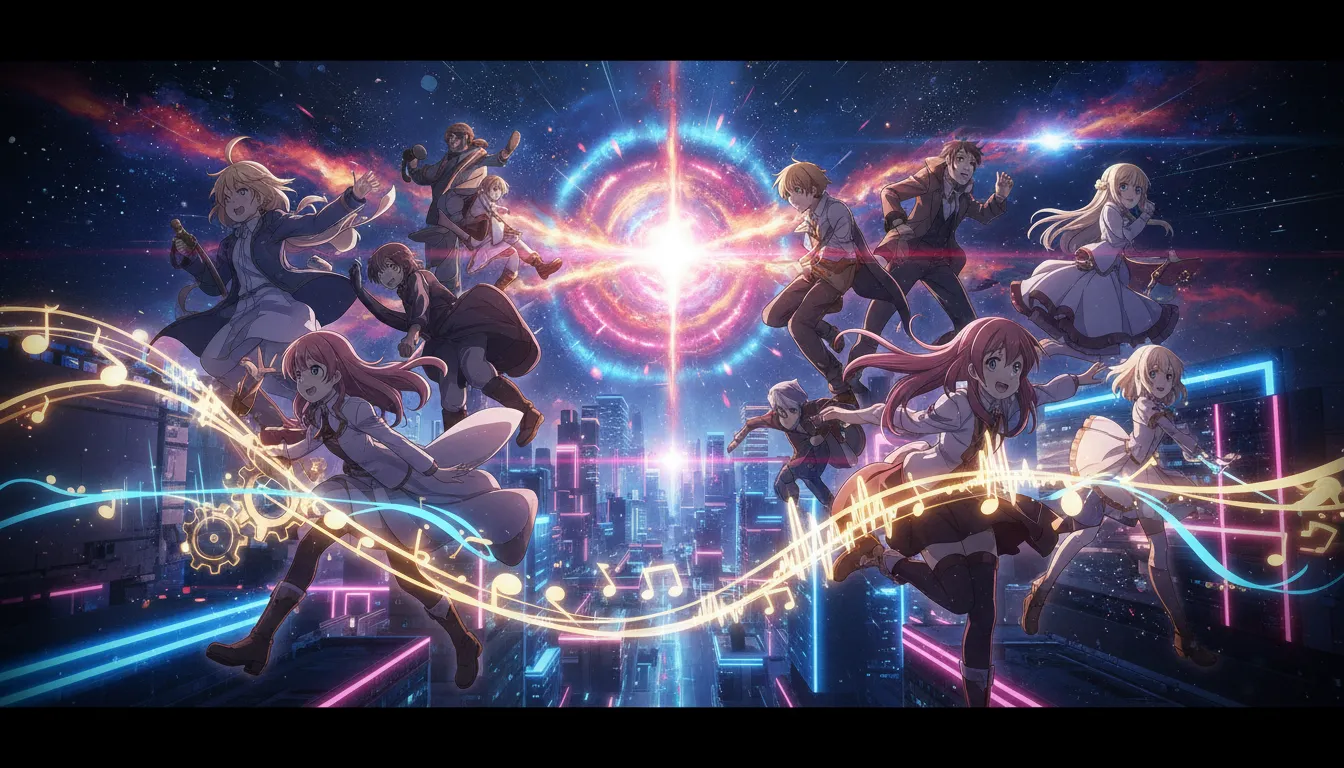
Why Anime themes explained matter
Anime themes explained is more than a phrase. It is a way to approach storytelling compressed into one-and-a-half minutes of music, image, and rhythm. Openings are the gateway between expectation and emotion. They set tone, introduce motifs, and promise an experience. When Anime themes explained are done well, they transform brief musical sequences into a lasting cultural shorthand for a series' identity.
We focus on how a single opening can carry narrative weight, character hints, and thematic resonance. Anime themes explained clarifies why certain songs feel inevitable for their shows and how visual choices work hand in hand with lyrics to sharpen meaning. This exploration uses a contemporary pop-anthem style opening as a case study, showing how heroism, spectacle, and intimacy coexist inside an energetic track.
What an opening has to accomplish
An opening theme faces a short checklist. It must introduce mood, provide memorable melodic hooks, and signal stakes. It also needs to give the audience emotional footholds: who matters, what the world looks like, and what kind of journey is beginning. Anime themes explained often highlight this dual task of spectacle and storytelling.
There are practical reasons for these demands. An opening has promotional function. It must be catchy for repeat listens. It must be evocative enough to stick in playlists. And on the storytelling side, it has to telegraph character dynamics and core conflicts in snippets of image and lyric. When people think of series identity, it is often the opening they remember—this is why Anime themes explained treats openings as compressed narrative engines.
Case study: a modern anthem about heroes and performance
Consider a co-ed pop group who are heroes in disguise, turning audience energy into combat power. That setup is both literal and metaphorical. It blends the tropes of idol culture and hero narratives. The opening under study rides this blend. The lyrics use explosive imagery—dawn light, calling voices, and references to becoming stronger—while the arrangement drives forward with pulsing beats and anthemic choruses.
When Anime themes explained uses this opening as an example, the focus is on three overlapping ideas: identity, conversion, and promise. Identity emerges through the performers and their dual life as artists and fighters. Conversion appears as a mechanic: performance energy becomes strength. Promise is the forward motion of the chorus. Each element is conveyed through short lyrical hooks and visual cues that reinforce one another.
Lyrics as symbolic shorthand
Lyrics operate on two levels: literal and symbolic. A line about a "calling from deep in a hot chest" works as an emotional image and as a symbol for destiny. Language like "I'll take you to the eco-bus ahead" reads oddly when translated literally, but the phrasing functions as futuristic travel toward a mission. Anime themes explained shows how lyrics that might seem abstract when isolated make sense against the show's worldbuilding.
熱い胸の奥から聞こえるコーリング
That line is a compact emotional flash. It announces an interior longing and a summons to action. When Anime themes explained examines such lines, it treats them as hooks that invite viewers to align with the characters' desire. Crisp vocal deliveries amplify these hooks, turning seemingly minor phrases into anthem-worthy refrains.
Hook, chorus, and repetition
Catchiness is engineered through repetition and contrast. The chorus offers the musical payoff: a melodically simple, emotionally broad phrase that is easy to sing along with. The arrangement layers harmonies and pushes dynamics at the chorus, making the sequence feel like a moment of collective uplift—mirroring the narrative idea of converting audience energy into power.
When Anime themes explained breaks down structure, it finds a predictable pattern: verse sets mood, pre-chorus builds tension, chorus rewards the buildup, and a bridge reframes stakes. This structure is compact but effective for storytelling. The small arc inside the opening echoes the larger series arc: progress, challenge, reinvigoration.
Visual language: how imagery and motion tell the story
Visuals are where themes both clarify and disguise story mechanics. Performers onstage, light flares, dawn imagery, and hero poses all communicate identity without exposition. Costume choices hint at powers and allegiances. Camera movement—close-ups for intimacy, wide shots for spectacle—signals where emotional emphasis should land. Anime themes explained pays special attention to how visual rhythm matches musical rhythm.
Quick cuts during drum fills, lingering wide shots on key symbols, and overlayed animation effects can indicate when the opening wants the audience to latch onto a motif. An opening that ties a visual motif (for example, a red flare or a shining emblem) to a lyrical line creates associative memory. The next time that motif appears in the story, the audience is already primed. This is the functional power behind deliberate design choices.
Layered reading: fan-level and narrative-level cues
Good openings reward different types of attention. Casual viewers gain mood and melody. Fans notice callbacks and subtle references—a character’s silhouette that hints at hidden power, a color palette shift that foreshadows conflict. Anime themes explained argues that the best openings operate simultaneously on both levels.
This layering builds investment. A single refractory image—like a performer clutching a microphone while a faint halo of light appears—works as a visually simple moment that later becomes meaningful when the same gesture recurs in a critical scene. Fans begin to decode and predict, which deepens engagement.
Themes inside the song itself: becoming, protection, and love as power
At the lyrical core are three themes: becoming stronger, the mission to protect, and love framed as transformative power. Lines about guarding the world or about being called to the dawn fuse youthful idealism with grand stakes. Anime themes explained reads these as classic anime motifs updated for contemporary pop sensibilities.
Becoming stronger is expressed as both a personal arc and a collective effect. The performers sing as individuals, but the chorus implies a communal uplift. This is aligned with the premise where audience energy feeds combat effectiveness. Protection is framed not as duty alone but as something energized by connection. Love is not just romantic; it is an empowering force—the kind that catalyzes supernatural effects.
強くなれる 君といるだけで
That lyric places connection at the heart of strength. When Anime themes explained highlights such lines, it treats them as thematic fulcrums that align the emotional stakes of episodes with the musical arc of the opening.
Why "love as power" resonates in modern openings
Love-as-power is a trope that reframes vulnerability as strength. In contemporary discourse, expressing emotion is often framed as courageous. The opening uses this to make its heroes accessible. Instead of being purely stoic defenders, they are people whose bonds fuel their ability to act. Anime themes explained shows that this approach broadens appeal: audiences who value emotional honesty connect more readily to heroes who are relational.
Musical choices that amplify narrative function
Production elements matter. A bright synth pad can suggest futuristic tech, while acoustic guitar gives intimacy. Percussive accents create urgency. Vocal production—double-tracking, harmonies, and call-and-response—creates a sense of crowd and camaraderie. Anime themes explained tracks how specific production choices map to narrative intention.
For example, an opening that wants to emphasize spectacle will lean into a wide stereo image and reverb-heavy vocals to sound larger than life. An opening that seeks intimacy will pull elements closer to the foreground with dry, present vocals and sparse accompaniment. The opening in focus balances both: big choruses for spectacle, intimate verses for emotional grounding. This balance reflects the show's dual nature—performers as entertainers and protectors.
Vocal arrangement and group dynamics
A co-ed group allows for conversational vocal arrangements. Male and female lines can alternate to suggest dialogue between characters or to mirror thematic duality: strength and tenderness, leader and supporter. Anime themes explained points to alternating lead lines and harmonized choruses as a way to dramatize relationship dynamics inside three musical minutes.
Harmonies often carry subtext. A unison line can signal unity; a tight harmony can imply shared purpose. Even brief call-and-response motifs suggest mentorship or mutual challenge. These micro-dramas occur within the music but mirror on-screen relationships.
How motifs become narrative anchors
Recurrent motifs—both musical and visual—act like anchors that the main story can tug on. A leitmotif tied to a character or an emblem will deepen each recurrence's emotional impact. When an opening's hook returns during a climactic scene, the audience experiences a cohesion between theme and payoff. Anime themes explained emphasizes how strategic motif placement can create satisfying echoes across a series.
- Melodic hooks that reappear in critical scenes strengthen emotional continuity.
- Visual symbols repeated in the opening and episodes build associative meaning.
- Rhythmic motifs tied to particular action styles make fights feel consistent across scales.
Anchors also help when the story evolves. If a character’s motif changes from major to minor mode, it signals emotional change. Anime themes explained treats these shifts as shorthand for character development without needing exposition.
Breaking down a bridge moment
The bridge in an opening often reframes everything that came before. It strips back texture or launches a contrasting passage to heighten the final chorus. In openings where the performers become heroes through connection, the bridge might feature whispered lines, a vocal solo, or a cinematic pause that makes the final chorus feel triumphant. Anime themes explained highlights the bridge as a narrative pivot point.
Applying these ideas beyond one song
Understanding how an opening works has practical value for creatives and analysts. Writers can learn how to condense character promise into short forms. Musicians can see how lyrical hooks pair with visual motifs. Marketers can design campaigns that replicate the opening's pattern of emotional engagement. Anime themes explained gives a toolkit for turning an opening into a predictive model for storytelling.
Use the following checklist when crafting or evaluating an opening:
- Identify the emotional core. Is it courage, love, revenge, hope, or something else?
- Map visual motifs to narrative beats. Does a color or object recur in key scenes?
- Assess musical structure. Where is tension built and released?
- Check vocal arrangement. Does it reflect character relationships?
- Ensure motifs can evolve. Can the main hook be reharmonized later to indicate growth?
Applying this checklist is a direct way to practice Anime themes explained methodologies. It turns passive appreciation into active craft.
How to read ambiguous phrases and translation quirks
Openings often feature lines that sound oddly poetic when translated. Literal translations can feel like fragments. That is intentional. Ambiguity creates space for audience imagination. In many cases, a phrase that reads as cryptic in English is functioning as an emotional signpost in Japanese or the original language. Anime themes explained encourages readers to prioritize feeling and image over literal fidelity when interpreting such lines.
For example, references to "dawn light" or "calling voices" may be less about setting and more about state of mind. An "eco-bus ahead" may read like a nonsensical object but can symbolize forward movement or a bridge to a new world. These images operate poetically within the opening’s economy of expression.
Practical tips for translating meaning
- Look at where the line appears musically. Is it during a buildup or release? That placement tells you whether it is a rhetorical climax or a connective line.
- Cross-reference with visuals. If the phrase shows up alongside an emblem or location, treat it as worldbuilding shorthand.
- Consider cultural metaphors. Some images resonate differently across cultures; research common metaphors for clearer understanding.
These tools make it easier to interpret lines that resist literal translation and to appreciate them as structured emotional cues.
How openings shape fan communities and rituals
Openings are ritualistic. Fans sing them together, create covers, and stage dances. That communal practice is not incidental. It mirrors the opening's theme when the track is about converting audience energy into something larger. Fans' participation completes the opening’s promise: community energy becomes a visible, audible force. Anime themes explained looks at openings as social objects that invite collaboration.
Community rituals also extend the opening's life cycle. Memes, remixes, and live performance recordings keep the song relevant beyond broadcast windows. The opening becomes an artifact fans use to communicate identity and belonging. When the opening speaks about connection and power, fan practices often literalize that sentiment.
From opening to performance: the real-world loop
A particularly potent opening closes the loop between diegetic performance (performers onstage inside the story) and non-diegetic performance (real-world concerts). The track studied here explicitly blurs those boundaries. As a result, in-universe concerts feel plausible and the real-world concerts feel mythic. Anime themes explained explores this feedback loop and why it deepens audience investment.
Lessons for creators
Creators can learn from openings how to condense narrative promise and design motifs that repay repeated attention. This is less about copying formulas and more about clarity of intention. Decide the core emotional move and then tune music, lyric, and visual to support it. Anime themes explained boils this down to three actionable directives:
- Prioritize a single emotional spine — choose one central feeling and let every element support it.
- Design motifs with versatility — ensure hooks can be reharmonized or recontextualized across the series.
- Balance spectacle and intimacy — alternate wide gestures with close moments to maintain human connection.
These directives help creators avoid two common mistakes. First, overstuffing the opening with too many competing motives. Second, making an opening so polished that it feels disconnected from the show's intimate moments. The best openings feel inevitable to the story they precede.
Using the opening as a classroom for narrative economy
Writers and educators can use openings as micro-lessons in narrative economy. Teaching students to capture a story's promise in 90 seconds helps sharpen their ability to write concise, evocative prose. Anime themes explained supplies a model: identify stakes, choose one emotional spine, and then craft motifs that can live beyond that short form.
Assignments might include rewriting an opening in a different genre, extracting leitmotifs and applying them to a character study, or composing a short visual storyboard that aligns with a sonic hook. These exercises train the skill of compressing narrative into memorable elements.
Final reflections on resonance and longevity
Openings last when they achieve coherence between sound, image, and theme. The specific opening analyzed here works because it commits to its core idea: performers-as-heroes whose bonds power them. That commitment informs every production decision, from vocal arrangement to visual motifs. Anime themes explained recognizes that a successful opening is not simply catchy; it is coherent, repeatable, and generative.
When a theme song ties together emotional stakes and worldbuilding, it becomes a cultural touchstone. It invites participation, spawns fan interpretations, and provides a shorthand for a series' identity. Creators and analysts who study openings through this lens learn how to craft moments that resonate long after the first listen.
What does it mean when an opening mixes performance and battle imagery?
Mixing performance and battle imagery creates a metaphor where public attention is a resource. It suggests that emotional energy can be weaponized for good. This combination humanizes heroes by framing their power as relational rather than purely physical.
How should ambiguous lyrics be interpreted?
Ambiguous lyrics function as emotional signposts. Prioritize placement, musical context, and visual cues over literal translation. Often the intended meaning is to evoke a state of mind rather than describe a plot point.
Why are motifs important in openings?
Motifs create associative memory. They let the opening prime audiences for later narrative payoffs. When motifs recur in critical scenes, the emotional impact multiplies because the audience has been conditioned to recognize and respond to them.
How can creators design an opening that feels integrated with the series?
Start with one emotional spine and design all elements around it. Make sure musical hooks, lyrical themes, and visual motifs can be adapted and reprised across episodes. Aim for coherence rather than maximal spectacle.
What role do fans play in an opening’s success?
Fans turn openings into rituals. Their covers, dances, and remixes keep the music alive and deepen communal bonds. When an opening’s theme is about connection, fan participation fulfills the concept, giving the opening practical power.
Can an opening predict the series’ arc?
Openings often foreshadow themes and sometimes plot beats. They rarely provide literal spoilers but can hint at character relationships, stakes, and emotional arcs. Treat them as thematic blueprints more than plot outlines.
Practical exercise for applying Anime themes explained
Try this short exercise to practice what Anime themes explained teaches. Pick any opening and follow these steps:
- Identify the opening's emotional spine in one sentence.
- List three visual motifs and note where they recur in episodes.
- Transcribe the chorus and analyze its harmonic structure—what makes it catchy?
- Rewrite the chorus to emphasize a different emotion and imagine how the visuals would change.
Completing this exercise trains attention to the economy of openings and helps creators translate that economy to longer formats.
How to keep learning
Study openings across genres and eras. Compare how a mecha series uses rhythm and how a slice-of-life series uses intimacy. Pay attention to how cultural moments affect production choices. The phrase Anime themes explained is a reminder to look beyond surface catchiness and ask why a song and sequence were designed the way they were.
We recommend compiling a playlist of diverse openings, isolating their choruses, and tracking recurring motifs across multiple series. Over time, patterns emerge. Those patterns are the grammar of a particular storytelling tradition.
Parting note on creative intent
Openings are promises. They promise mood, they promise growth, and they promise a kind of shared experience. When creators and audiences align on that promise, the opening becomes more than a sequence: it becomes a contract of expectation. Anime themes explained shows how reading that contract carefully reveals a deeper architecture behind seemingly fleeting entertainment.
This article was created from the video SI-VIS: The Sound of Heroes Opening 2 | "Supernova" with the help of AI.
Anime themes explained: Decoding the Heart of "Supernova" and What Makes an Opening Stick. There are any Anime themes explained: Decoding the Heart of "Supernova" and What Makes an Opening Stick in here.
Sponsor

